Reconstitution guide: mixing, calculations and storage
Updated October 18, 2026
Medical information: Follow the prescribed product instructions and pharmacist's guidance. This guide does not replace injection training. Research-use-only materials are not approved medicines.
What is reconstitution?
Reconstitution means adding liquid to powder. Lyophilized means freeze-dried. A diluent is the liquid specified for mixing. Preparation guidance.
BAC water contains a preservative. BAC water, preservative-free water, and saline are not automatic substitutes. Use the liquid specified for the product. Water label.
Freeze-drying does not establish sterility or a storage period. FDA manufacturing guide.
Mixing steps
Injection guide: Injection sites and site rotation.
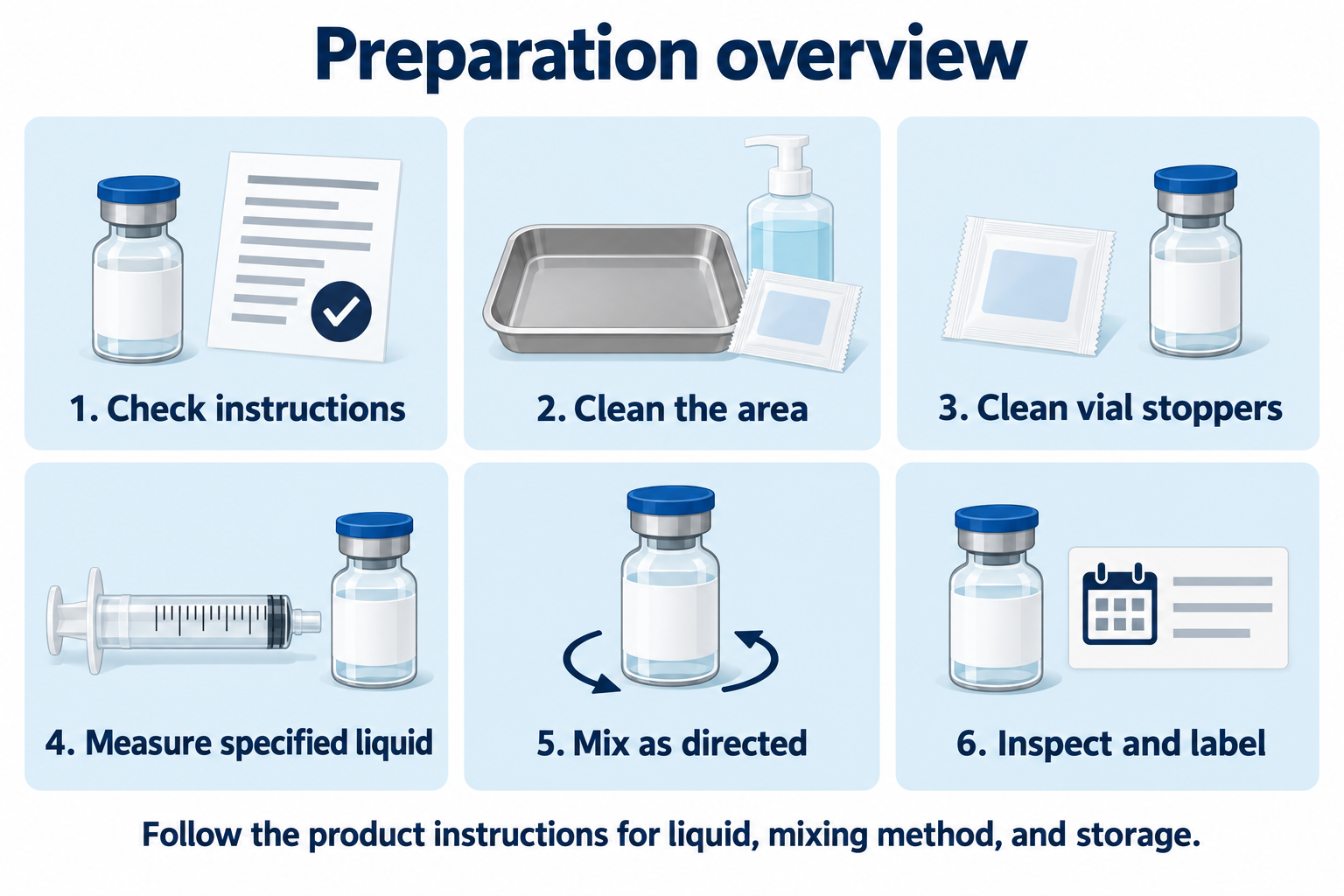
Before mixing: Confirm the product, vial strength, injection route, diluent, added volume, mixing method, and storage instructions. If instructions are missing or conflicting, ask the dispensing pharmacist before proceeding. Preparation guidance.
- Check supplies. Check expiration dates, seals, and packaging. Do not use damaged or expired supplies.
- Prepare the area. Clean and disinfect the work surface away from sinks and used equipment. Wash and dry your hands.
- Clean the stoppers. Wipe each rubber stopper with alcohol. Let it dry. Do not touch cleaned stoppers or exposed needles.
- Measure the liquid. Use the specified sterile syringe or transfer device. Measure the exact diluent volume in the product instructions.
- Add and mix. Follow the product's transfer method, speed, and mixing time. If instructions specify gentle swirling, do not shake.
- Inspect the solution. Check its specified appearance. If unexpected particles, cloudiness, or color changes appear, stop and contact the pharmacist.
- Label and store. Record the product, concentration, preparation time, and discard time. Store as directed.
- Discard used equipment. Put used needles and syringes in a sharps container. Use a new sterile needle and syringe for each vial entry.
Do not leave a needle in the stopper. Clear appearance does not prove sterility. If contamination is suspected, discard the vial. CDC guidance, pharmacy instructions, product instructions.
 Tap image to enlarge
Concentration calculations
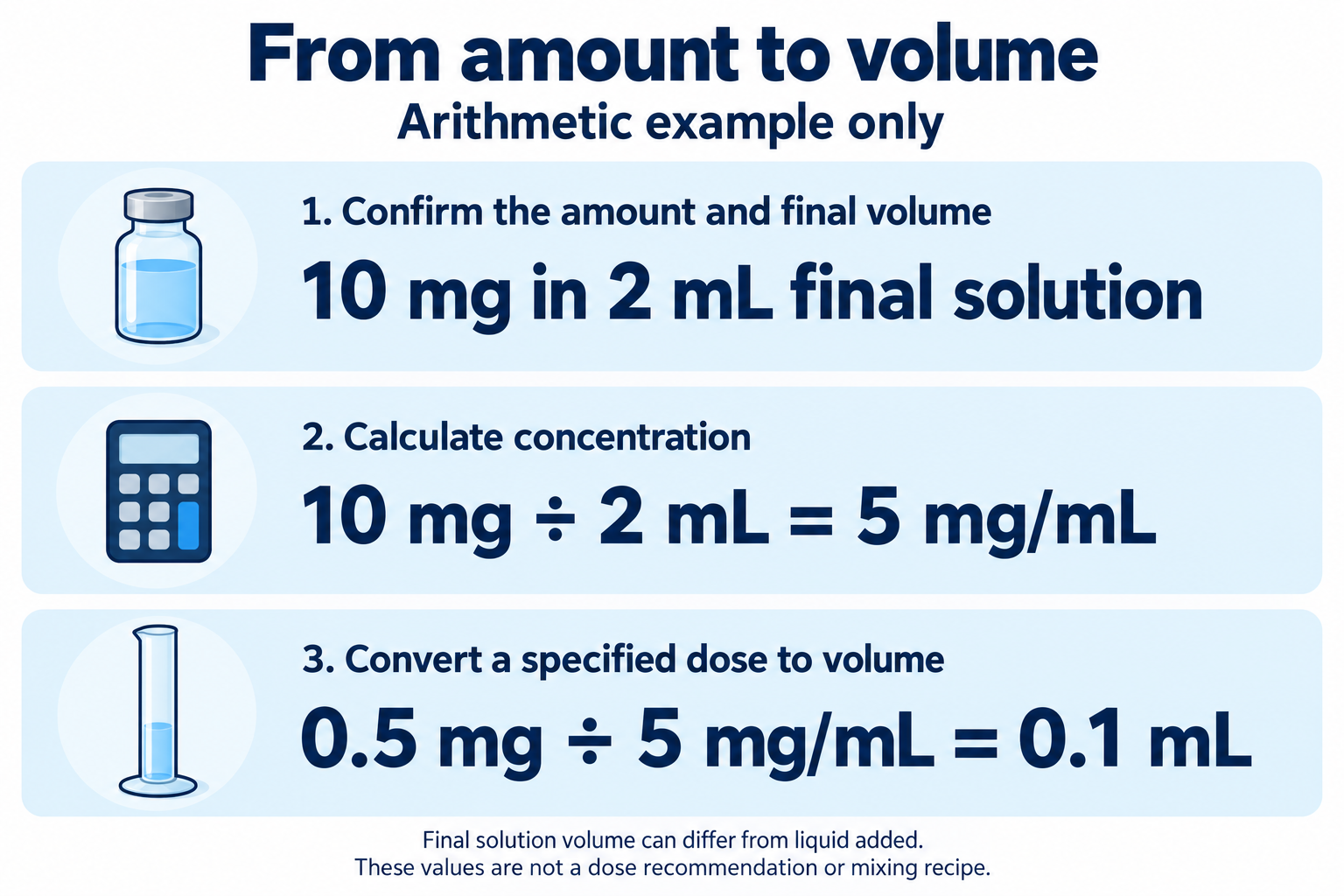
Concentration (mg/mL) = compound amount (mg) ÷ final solution volume (mL).
Dose volume (mL) = specified dose (mg) ÷ concentration (mg/mL).
Final volume (mL) = compound amount (mg) ÷ target concentration (mg/mL).
A milligram (mg) and microgram (mcg) measure mass. A milliliter (mL) measures volume. 1 mg = 1,000 mcg. Calculation guide.
Arithmetic examples; not dose recommendations or mixing recipes:
| Calculation | Result |
|---|---|
| 10 mg ÷ 2 mL final solution | 5 mg/mL |
| 0.5 mg ÷ 5 mg/mL | 0.1 mL |
| 10 mg ÷ 5 mg/mL target concentration | 2 mL final solution |
| 500 mcg ÷ 1,000 | 0.5 mg |
 Tap image to enlarge
Added liquid can differ from final volume. Dissolved powder can increase volume. Use the product's stated final volume or concentration. Vial capacity is not solution volume. Calculation guide.
A nominal concentration assumes that final volume equals added liquid. For blends, calculate each ingredient from its own mass.
Syringe marks: On a U-100 syringe, 100 units = 1 mL; 10 units = 0.1 mL. These marks measure volume, not peptide mass.
If the volume falls between syringe marks, ask the pharmacist for suitable equipment. Do not assume each line equals one unit. Do not round the dose or change the mixture yourself. FDA measurement guidance.
Tools: Concentration calculator · Dose-to-volume calculator.
Storage and discard rules
| Item | Rule |
|---|---|
| Storage | Follow each product's temperature and light-protection instructions. Refrigeration is not automatic. |
| Unopened vial | Follow the manufacturer's expiration date and storage conditions. |
| Opened multidose vial | Date the first puncture. Discard within 28 days, unless the manufacturer specifies another period. Never exceed the original expiration date. |
| Reconstituted medicine | Follow its own discard time. BAC water does not give every mixture a 28-day shelf life. |
| Single-dose vial | Discard leftovers after use. Do not save them for another injection. |
| Suspected contamination | Discard the vial, even if the solution looks normal. |
CDC vial guidance, product instructions.
If a temperature limit was exceeded, ask the pharmacist before further use. A calculator cannot establish stability or extend storage. Preparation guidance.
Why storage rules differ
EGRIFTA WR illustrates product-specific limits. These rules apply only to that prescribed tesamorelin formulation:
| Item | EGRIFTA WR instructions |
|---|---|
| Diluent | Only the supplied Bacteriostatic Water for Injection |
| Mixed medicine | Store at 20–25°C. Discard seven days after mixing. Do not refrigerate or freeze. |
| Supplied water vial | Discard 28 days after first use. |
EGRIFTA WR prescribing information and Instructions for Use.
Compound guides
Select a compound for preparation examples, dosing schedules, and evidence limits.
Medical notice: Ask the dispensing pharmacist about the actual product. Correct arithmetic does not establish identity, purity, solubility, sterility, stability, or compatibility. See Research Use Only.